
Prefer to listen? Stream the automated discussion of this playbook.
Official DF Playbook Audio (Apr 22, 2026). Discover how to beat cold email volume decay by tracking real-time infrastructure micro-signals.
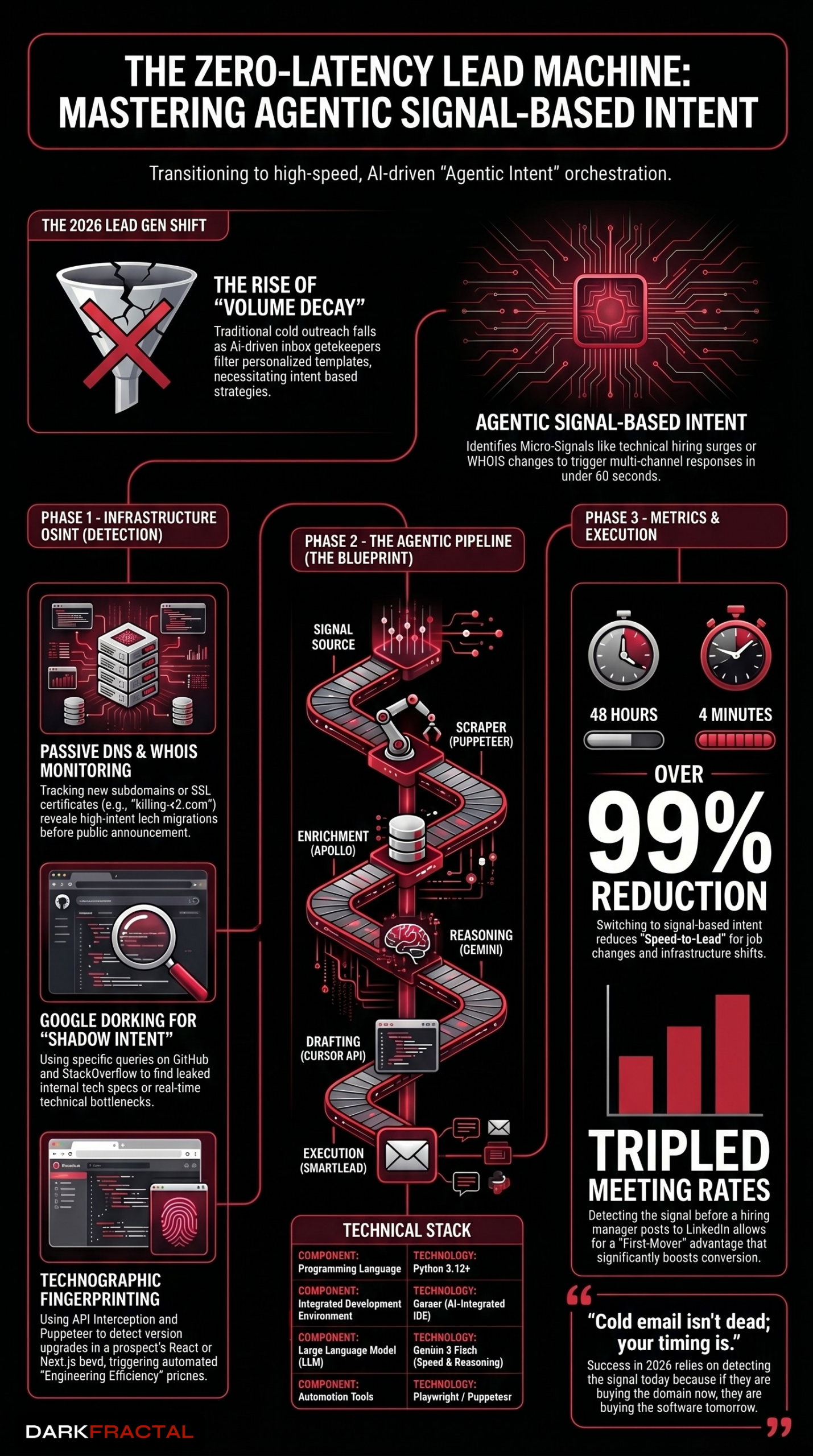
The B2B lead generation landscape shifted fundamentally this month. If you are relying on traditional cold outreach, you are suffering from “Volume Decay.” Even highly personalized templates are now instantly filtered by AI-driven inbox gatekeepers.
The most impactful trend dominating April 2026 is Agentic Signal-Based Intent Orchestration.
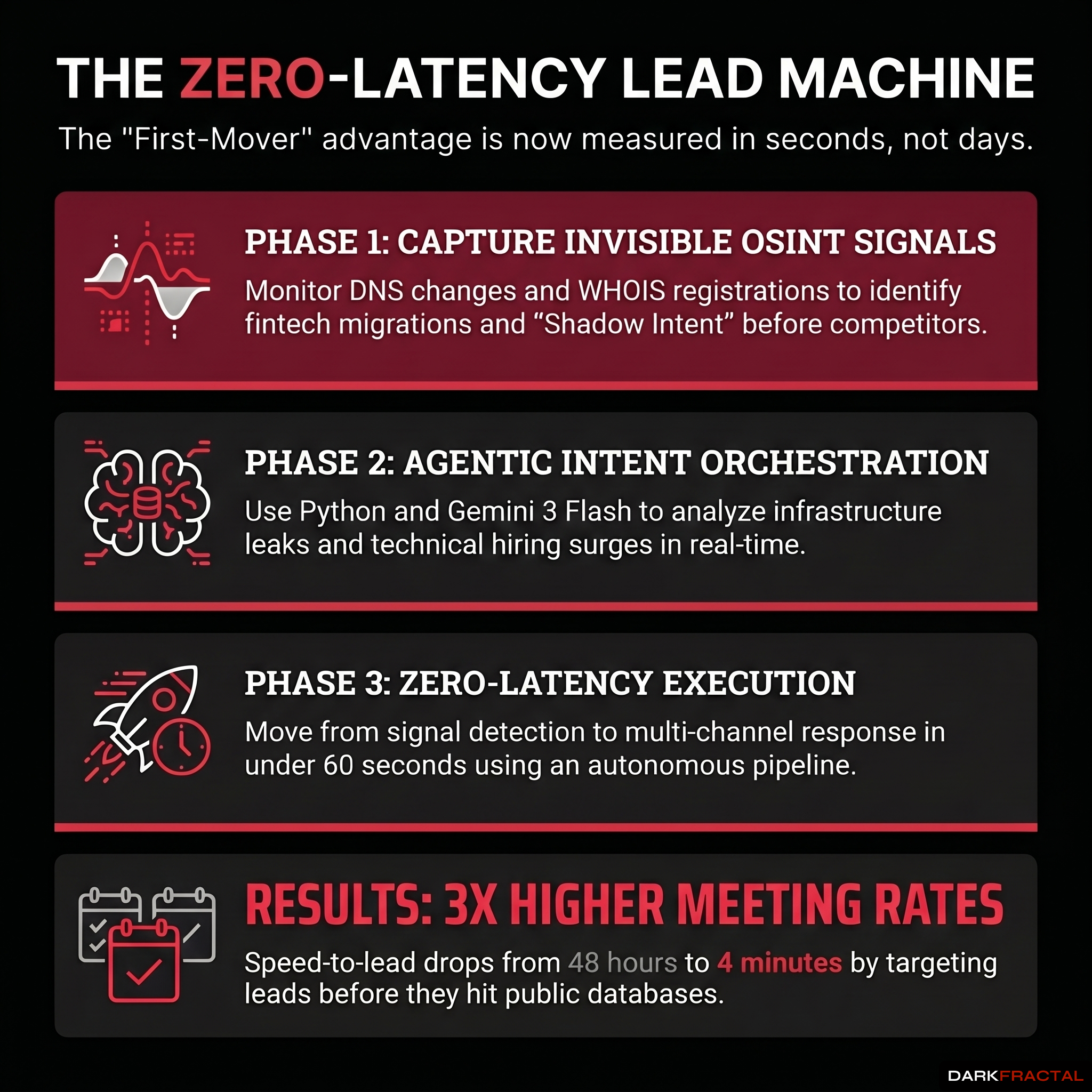
Unlike traditional intent data—which vaguely tells you a company is “researching” a category—Agentic Intent identifies immediate Micro-Signals. These are specific technical hiring surges, localized WHOIS domain changes, or “Infrastructure Leaks.” Modern pipelines then use autonomous AI agents to execute a hyper-relevant, multi-channel response in under 60 seconds.
Here is how top companies are building OSINT pipelines to capture “Invisible Leads” before they ever hit generic databases like Apollo or ZoomInfo.
Phase 1: OSINT Technical Analysis & Signal Extraction
To outpace the market, you must monitor infrastructure, not just job titles. The “First-Mover” in 2026 is the one who detects the signal before the hiring manager even posts the job to LinkedIn.
1. Passive OSINT: The “DNS & WHOIS” Signal
If a target company registers a new domain today, they are buying software to support it tomorrow.
The Workflow: Monitor new subdomains and SSL certificate issuances for target accounts in real-time.
The Logic: If a prospect registers
payments.target.comorbilling-v2.target.com, they are actively undergoing a fintech or infrastructure migration. This is a significantly higher intent signal than a whitepaper download.Google Dorking for “Shadow Intent”: * Find leaked internal tech specs:
site:github.com "target-company.com" "config" -is:publicFind real-time technical bottlenecks:
site:stackoverflow.com "target-company.com" "[specific-tech-stack]"
2. Active Scraping: Technographic Fingerprinting
Standard HTML scraping is dead. Modern pipelines use API Interception and Technographic Fingerprinting to extract high-frequency signals.
The Architecture: Deploy Python + Puppeteer to “fingerprint” a prospect’s site. Instead of looking for a static meta tag, your scraper detects the specific version of their React or Next.js bundle.
The Execution: If the script detects they just upgraded their core stack, it instantly triggers an “Engineering Efficiency” pitch tailored to that exact migration.
Phase 2: The Developer Blueprint (Agentic Pipeline)
This blueprint outlines how to build an automated prospecting engine that moves from signal detection to execution with zero latency.
A. The Data-Flow Architecture
Signal Source (WHOIS/Job Board) → Scraper (Puppeteer) → Enrichment (Apollo/LinkedIn) → Reasoning (Gemini) → Drafting (Cursor API) → Execution (Smartlead/Instantly)
B. The Technical Stack
Language: Python 3.12+
Environment: Cursor (AI-integrated IDE)
LLM: Gemini 3 Flash (Optimized for high-speed, high-context reasoning)
Automation: Playwright/Puppeteer (For active, headless scraping)
C. Core Code Blueprint
1. The “Signal Listener” (Job Surge Detector) This script monitors specific job board keywords to find companies actively building new departments, catching them at the exact moment they have budget.
import asyncio
from playwright.async_api import async_playwright

async def get_job_signals(keyword, company_domain):
    async with async_playwright() as p:
        browser = await p.chromium.launch(headless=True)
        page = await browser.new_page()

        # Dorking LinkedIn Jobs via Google for high-intent signals
        search_url = f"https://www.google.com/search?q=site:linkedin.com/jobs/+'{keyword}'+at+'{company_domain}'"
        await page.goto(search_url)

        # Extract job titles and post dates
        jobs = await page.query_selector_all('h3')
        signals = [await job.inner_text() for job in jobs]

        await browser.close()
        return signals
2. The AI Personalizer (Gemini 3 Flash) This function acts as the reasoning engine. It takes the raw OSINT signal and drafts a highly technical, “Peer-to-Peer” email.
import google.generativeai as genai

# Initialize the rapid-reasoning model
genai.configure(api_key="YOUR_GEMINI_API_KEY")
model = genai.GenerativeModel('gemini-3-flash')

def generate_agentic_pitch(company, signal_data):
    prompt = f"""
    Target: {company}
    Signal Detected: {signal_data}

    Task: Write a strictly 2-sentence technical 'Why Us Now' email.
    Rule 1: Never use 'I hope this finds you well.'
    Rule 2: Directly reference the specific job surge or infrastructure change found in the signal.
    Rule 3: Frame our product as the exact 'missing piece' for their current build.
    Output: Only the raw email text.
    """
    response = model.generate_content(prompt)
    return response.text.strip()
Phase 3: The Actionable Playbook
Cold email isn’t dead; your timing is. By switching from static lists to Signal-Based Intent, early adopters are reducing their “Speed-to-Lead” for infrastructural changes from 48 hours to 4 minutes—and tripling their meeting rates as a result.
Your 48-Hour Execution Step: Open Cursor today, trigger Composer (Cmd+I), and command the AI:
“Build a FastAPI wrapper for a Python Job Signal Detector. Add an endpoint that triggers a Gemini-generated draft directly to my Slack whenever a new high-intent keyword is found.”
Turn Your Pipeline into a Sales Engine
We don’t do confusing agency jargon; we engineer pipelines that generate measurable sales growth. If you are ready to implement Agentic Intent, automate your outbound, and streamline your revenue operations, we provide the technical firepower.
[Subscribe to DF Subscriptions at darkfractal.io] to leverage our 14-day Agile sprints and 48-hour turnarounds. It’s digital clarity, with results you can see.